
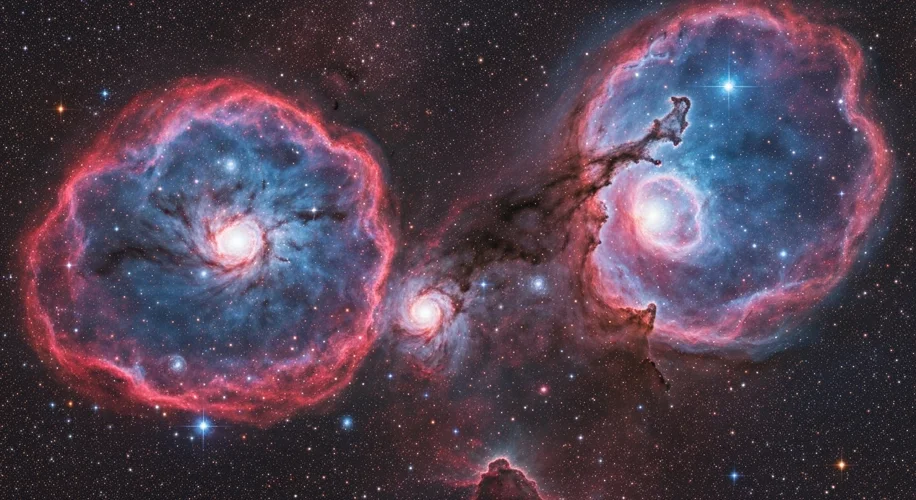
It’s September 9th, 2025, and today I want to take you on a journey, not across continents, but across the vast expanse of our universe. Specifically, we’re heading to the Cygnus Region, a part of the sky that astrophotographers and astronomers alike find endlessly fascinating. If you’ve ever been captivated by stunning images of nebulae and the mysteries of black holes, then this is for you.
What is the Cygnus Region?
The Cygnus Region is a prominent area in our night sky, easily visible during the summer months in the Northern Hemisphere. It’s home to a dense collection of stars, gas, and dust, making it a prime target for observing some of the universe’s most spectacular phenomena. Named after the constellation Cygnus, the Swan, it’s often depicted as a celestial bird in flight.
A Canvas of Cosmic Art
This region is particularly famous for its nebulae, which are immense clouds of gas and dust. These cosmic nurseries are where new stars are born. Think of them as celestial art studios, painted with vibrant colors by the light of young, hot stars. The intense radiation from these stars ionizes the gases, causing them to glow. Some of the most iconic nebulae, like the North America Nebula and the Pelican Nebula, are found here. They showcase incredible detail, revealing intricate structures and vast interstellar landscapes that are truly breathtaking.
Did you know that the colors we see in nebulae images aren’t always what our eyes would perceive directly? Astrophotographers use special filters and processing techniques to capture and enhance the different wavelengths of light emitted by various elements, like hydrogen and oxygen. This allows us to see the universe in a way that reveals its hidden beauty and complexity.
The Allure of Black Holes
The Cygnus Region also holds a special place in our understanding of black holes. One of the most intriguing objects is Cygnus X-1, one of the first confirmed black holes. It’s a binary system where a massive blue star orbits an invisible companion – the black hole. The black hole’s immense gravity pulls material from the star, forming an accretion disk that heats up and emits powerful X-rays, which is how we can detect it.
Black holes, with their insatiable gravity, warp spacetime around them. While we can’t see them directly, their influence on surrounding matter provides compelling evidence of their existence. Studying these objects helps us test the limits of physics and deepen our understanding of gravity and the very fabric of the cosmos.
A Source of Scientific Curiosity
Looking at the Cygnus Region reminds me of the sheer scale and complexity of the universe. It’s a visual testament to the power of scientific inquiry. Much like how I study atmospheric phenomena, which can be just as vast and complex, these celestial observations push the boundaries of our knowledge. It sparks a sense of wonder and encourages us to keep asking questions about our origins and our place in the universe.
The beauty and scientific significance of the Cygnus Region offer a wonderful opportunity to appreciate the cosmos. It’s a reminder of the incredible discoveries that await us as we continue to explore the depths of space.