
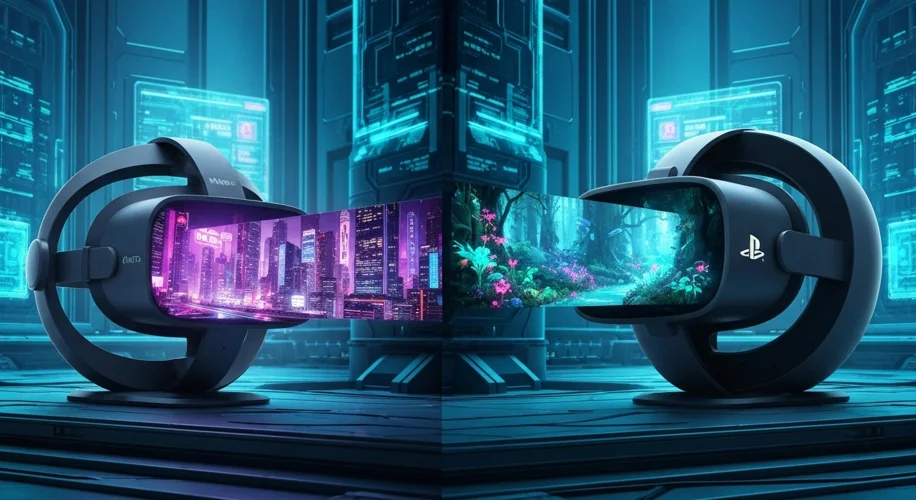
Okay, so hear me out… I recently dove headfirst into the world of virtual reality with a new PlayStation VR2, and honestly, it’s been a trip. As someone who’s tinkered with VR before – my trusty Pico 4 is still around – I was super curious to see how the PSVR2 stacked up, and also how it compares to the Meta Quest 3, which has been making waves.
Let’s get into it.
First Impressions: Visuals and Comfort
The PSVR2’s OLED display is seriously impressive. The colors pop, the blacks are deep, and the overall clarity is a noticeable step up from what I was getting with my Pico 4. Playing games like Horizon Call of the Mountain felt incredibly immersive. The headset itself is also pretty comfortable for longer sessions, though it does have a bit of a front-heavy feel sometimes.
Compared to the Quest 3, the PSVR2 has that advantage of being tethered to a PlayStation 5, which means consistently powerful performance without needing to worry about battery life or Wi-Fi streaming quality. The Quest 3, on the other hand, is a standalone powerhouse. Its passthrough feature, which lets you see the real world in color, is way better than older headsets, making mixed reality experiences a genuine possibility. The Quest 3 is also generally lighter and more compact.
Performance and Features: What’s Under the Hood?
This is where the comparison gets interesting. The PSVR2, with its eye-tracking and foveated rendering, offers some really smart tech. Eye-tracking means the headset knows where you’re looking and can render that part of the scene in higher detail, which is pretty cool for performance. The haptic feedback in the controllers and even the headset itself adds another layer of immersion that’s hard to beat.
The Quest 3, being standalone, is a marvel of engineering. It’s running its own mobile processor, and it handles a surprising amount of graphical power. What it lacks in direct console power, it makes up for in versatility. You can play games without any wires, connect it to your PC for more demanding titles, and its mixed-reality capabilities are truly pushing boundaries.
The Experience: Exclusives and Ecosystem
One of the biggest draws for the PSVR2 is its access to PlayStation exclusives. Games like Horizon Call of the Mountain, Gran Turismo 7 VR, and Resident Evil Village on PSVR2 are fantastic and really showcase what the platform can do. It’s a curated, high-quality library that leverages the PS5’s power.
The Quest 3, however, has a much larger and more diverse library, including many PC VR titles that can be streamed wirelessly. Meta’s ecosystem is also rapidly expanding, with a strong push into mixed reality and social VR applications. The freedom of going wireless is a huge plus for many, myself included.
My Verdict (So Far!)
Both headsets offer unique experiences. If you’re already in the PlayStation ecosystem and want a powerful, dedicated VR experience with some truly stunning exclusives, the PSVR2 is a fantastic choice. The visual fidelity and immersive haptics are top-notch.
However, if you’re looking for more versatility, the freedom of wireless play, and a gateway into mixed reality and a wider range of VR content (including PC VR), the Quest 3 is probably the way to go. Its standalone nature and evolving mixed-reality features make it feel like a glimpse into VR’s future.
I’m still exploring everything both have to offer, but it’s an exciting time to be in VR. What are your thoughts? Let me know in the comments!