
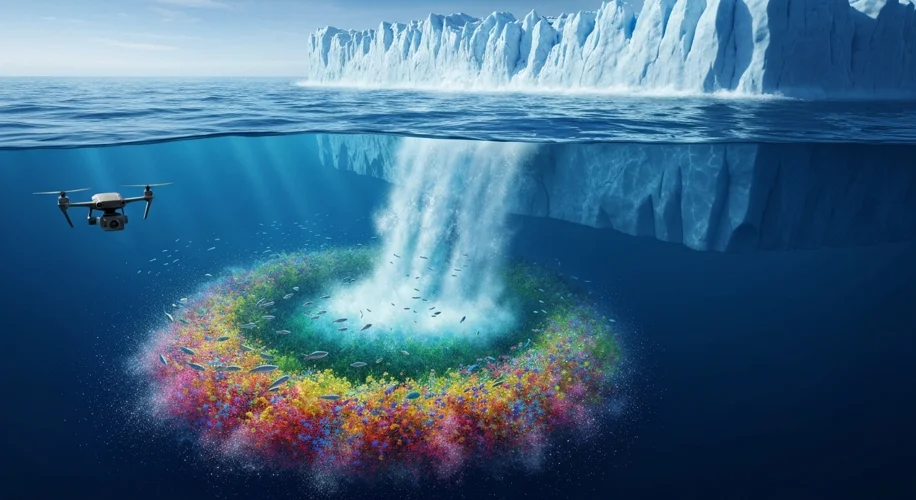
Did you know that Greenland’s melting ice sheets are like giant, underwater fertilizer factories? It sounds a bit wild, but that’s exactly what NASA’s supercomputers are helping us understand.
For years, scientists have been watching Greenland’s glaciers retreat. It’s a visible sign of our changing climate, but what happens under the ice, where the meltwater meets the ocean, is something we’re only just beginning to fully grasp.
A Hidden Feast for Marine Life
When massive chunks of ice break off and melt, they release more than just fresh water. They also release nutrients, like iron, that have been locked away in the ice for centuries. Think of it as a massive, slow-motion release of an essential building block for life.
NASA’s powerful supercomputers have been crucial in simulating these complex processes. They help scientists model how this meltwater, rich in iron and other minerals, spreads through the ocean currents. This research, which has been highlighted by sources like The Daily Galaxy and NASA.gov, shows that these nutrient-rich waters create surprisingly fertile zones for marine ecosystems.
The Science Behind the Bloom
Marine life, especially tiny organisms like phytoplankton, rely on these nutrients to grow. Phytoplankton are the base of the ocean’s food web, similar to how plants are the base of food on land. When they have access to more iron and other essential elements, they can bloom – essentially, they multiply rapidly.
This isn’t just a small, localized effect. As the glaciers melt more significantly, these nutrient plumes can extend further, potentially impacting larger areas of the ocean. This has implications for everything from the smallest zooplankton to larger fish and marine mammals that feed on them.
Looking Closer at the Ice Edge
Scientists are particularly interested in what happens right at the edge of the glaciers, where the ice meets the sea. Studies mentioned in outlets like ScienceBlog.com and The Environment Journal emphasize that this is where the most dramatic changes are occurring. The sheer amount of ice being lost means these nutrient-rich meltwater flows are becoming more significant.
While the melting ice is a clear indicator of climate change and a cause for concern, this research also sheds light on a fascinating, albeit complex, ecological response. It’s a reminder that even in the face of environmental challenges, nature often finds surprising ways to adapt and create new opportunities for life.
Understanding these intricate connections, powered by advanced technology like NASA’s supercomputers, is vital. It helps us build a clearer picture of how our planet is responding to change and what it means for the incredible diversity of life beneath the waves.