Did you know that the floor of the ocean might hold clues to a dramatic event that changed our planet’s climate? Recent scientific discoveries point to evidence found in ocean sediments suggesting a massive comet explosion around 12,800 years ago.
This wasn’t just any small space rock encounter. Scientists are exploring the theory that this cosmic event could be linked to the Younger Dryas, a period of significant and abrupt cooling that occurred at the end of the last Ice Age. For about 1,400 years, parts of the Earth experienced much colder temperatures and drastic climate shifts, which had a profound impact on ecosystems and early human populations.
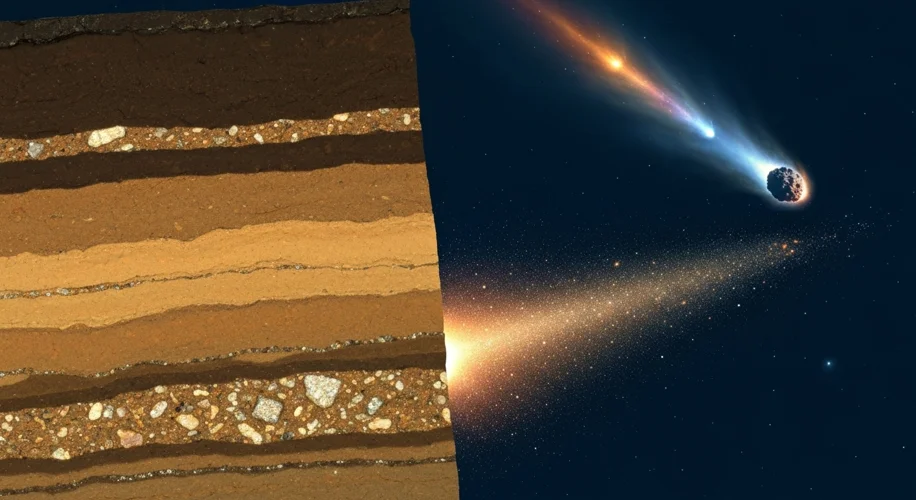
What’s fascinating is the specific evidence being unearthed. Researchers have found extraterrestrial particles, like nanodiamonds and platinum, embedded in sediment layers. These particles are like tiny fingerprints left behind by the immense heat and energy of a cosmic impact or airburst. The locations where these particles are found are crucial – they span across different continents, suggesting a widespread event.
One of the key areas of research involves deep-sea sediments. These layers act like a historical record, preserving clues about what was happening on Earth millions of years ago. By analyzing the composition of these sediments, scientists can detect traces of materials that don’t originate from Earth, pointing to an extraterrestrial source. The discovery in the Baffin Sea, for instance, is providing direct evidence of a comet fragment impact.
So, how does this change our understanding of climate history? It offers a potential explanation for the sudden onset of the Younger Dryas. While there are other theories for climate shifts, a major extraterrestrial event provides a powerful trigger mechanism. It suggests that our planet’s climate is not only influenced by internal factors but can also be dramatically altered by external cosmic forces.
This research is ongoing, and it’s a great example of how we’re constantly learning more about Earth’s dynamic past. By looking to the depths of the ocean and the makeup of ancient sediments, we’re piecing together a more complete picture of the events that have shaped our world.