
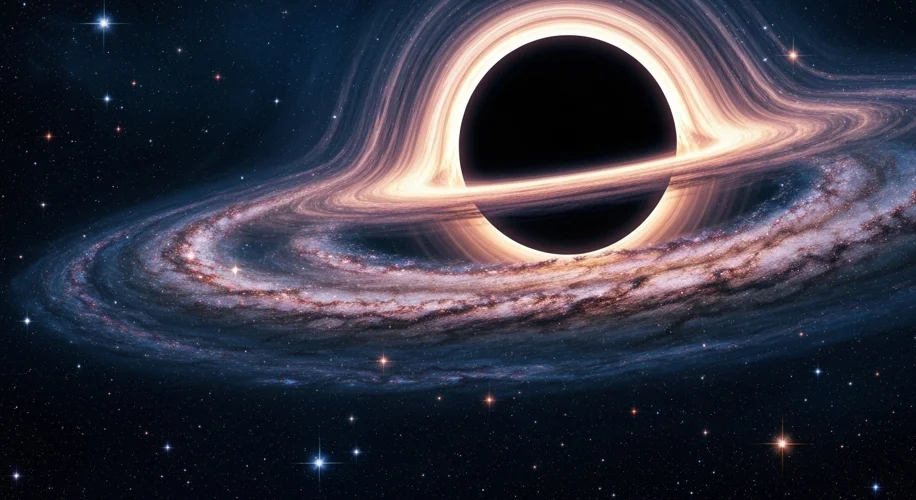
Did you know there’s a monster out there in the cosmos? Scientists have recently discovered a black hole so massive, it’s hard to even wrap your head around. This isn’t just big; it’s colossal! We’re talking about a black hole with a mass equivalent to 36 billion of our suns.
Let’s put that into perspective. Our sun is already a pretty hefty star. Now imagine 36 billion of them squished together, or rather, orbiting something so dense and powerful that not even light can escape its gravitational pull.
This incredible find was made possible by astronomers studying distant galaxies. These supermassive black holes often reside at the center of galaxies, and their sheer size can influence the entire galaxy around them. While we’ve known about supermassive black holes for a while, finding one of this magnitude is a significant event.
What makes this particular black hole stand out is its sheer mass. For context, the black hole at the center of our own Milky Way galaxy, Sagittarius A*, is estimated to be about 4 million times the mass of our sun. So, the newly discovered behemoth is about 9,000 times more massive than our galactic center! It’s like comparing a grain of sand to a mountain.
Scientists are excited because discoveries like this help us understand the evolution of galaxies and the role black holes play in that process. How do such gigantic black holes form? Do they grow by consuming matter, or do they form from the collapse of a massive star? These are the questions that drive astronomical research.
This discovery was made using advanced telescope technology, allowing us to peer deeper into the universe and observe phenomena that were once beyond our reach. It’s a testament to human curiosity and our drive to explore the unknown.
While the idea of such a massive object can sound intimidating, it’s important to remember that it’s incredibly far away. Its immense gravitational pull is contained within its event horizon, and it poses no threat to our own solar system. Instead, it offers a fascinating window into the extreme conditions that exist in the universe.
As we continue to explore the cosmos, who knows what other wonders await discovery? This latest find reminds us that the universe is a vast and often surprising place, constantly revealing new secrets.