
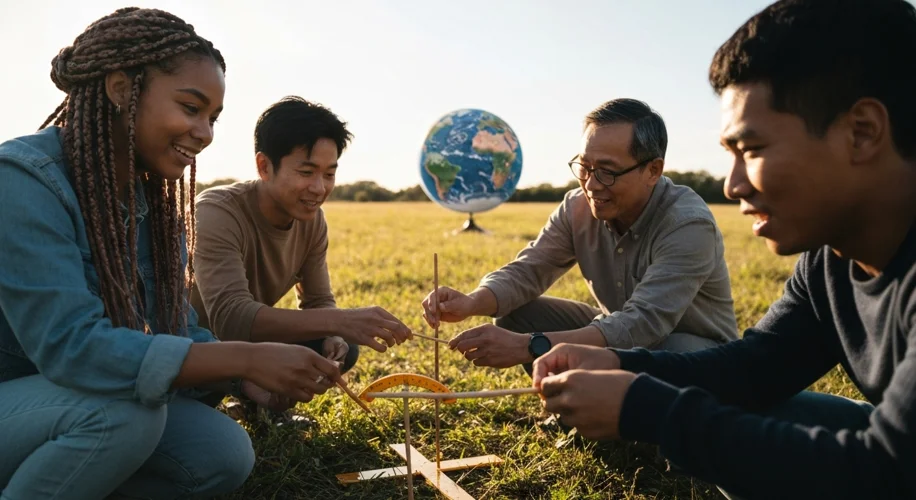
Friends, have you ever stopped to think about the sheer scale of our planet? We live on a sphere, spinning through space, and for centuries, understanding its exact size has been a monumental scientific quest. Today, I want to invite you to be a part of that history.
Back in the day, around 240 BC, a brilliant Greek librarian named Eratosthenes performed a remarkable feat. He calculated the Earth’s circumference with surprising accuracy, all without leaving his library! How? By using simple geometry and observations of shadows.
Eratosthenes knew that on the summer solstice, at noon in Syene (modern Aswan), the sun was directly overhead, casting no shadow in deep wells. Meanwhile, in Alexandria, further north, the sun cast a shadow. He measured the angle of this shadow and knew the distance between Syene and Alexandria. By comparing the angle of the shadow to the total degrees in a circle (360), he could estimate the Earth’s total circumference.
His method was ingenious, and it forms the basis of a fantastic citizen science project we can all participate in. It’s a direct way to engage with the scientific method and understand a fundamental truth about our home planet.
How You Can Join In
We’re going to do something similar, but with a modern twist. The idea is to have people across different latitudes measure the angle of the sun at the same time. You don’t need fancy equipment, just a sunny day, a stick (a gnomon), a flat surface, and a way to measure angles – even a protractor app on your phone can work!
Here’s the basic approach:
- Find a Sunny Spot: On a clear day, find a location with an unobstructed view of the sun.
- Set Up Your Gnomon: Place a straight stick vertically into the ground. Make sure it’s as perpendicular as possible. A plumb bob can help here.
- Measure the Shadow: At a specific, agreed-upon time (like local solar noon, which you can often find online for your location), measure the length of the shadow cast by your stick.
- Measure the Stick: Measure the exact height of the stick from the ground.
- Calculate the Angle: Using simple trigonometry (specifically, the tangent function: tan(angle) = shadow length / stick height), you can calculate the sun’s angle at that moment.
The Collective Power
What makes this project truly powerful is participation. If many people, at known locations (latitudes), perform this measurement, we can combine our data. By comparing the sun’s angle at different latitudes at the same time, we can triangulate and get a new estimate for Earth’s circumference.
It’s a reminder that science isn’t just done in labs or by a select few. It’s something we can all do, right in our own backyards. It connects us to the planet and to each other, across vast distances. Let’s channel our inner Eratosthenes and make some measurements!